Lured by the glamorous promise of Silicon Valley, high salaries, and the allure of working on the technology of the future, more people now than ever are asking themselves: “Is a career in AI a sensible choice for me?” Despite the media’s intense focus on AI’s potential, this is a question that deserves more than just a superficial analysis.
In this article, we won’t shy away from the hard truths; we’re going one step beyond the common enthusiasm to explore the less spoken-about facets of AI as a career. Our aim is to provide a genuinely grounded, strategic perspective to help you decide if the world of AI is the right place for your skills and passion.
AI Careers: A Dissected Ecosystem Not a Singular Path
Splashed across headlines, there’s an unmistakable buzz about the job opportunities unfolding in the realm of artificial intelligence (AI). Yes, we do see a surge in demand for AI roles, but let’s dust off the hype and delve a little deeper, shall we?
We mustn’t forget that AI isn’t a career in itself, but a colossal ecosystem consisting of numerous roles, each possessing its unique DNA. From rote coding to inventive AI research, the spectrum is indeed broad and diverse. The tides are turning increasingly towards the application and integration of AI technologies rather than bare-bone research. This shift calls for a blend of tactical and strategic acumen, matched with a conscious effort to keep up with the relentless pace of change— an innate characteristic of the AI industry.
The world of AI careers, thus, demands a continuous learning commitment; you can’t just tick a box and rest on your laurels. In our exploration of the AI job landscape, it’s becoming clear that for job sustainability, embracing adaptability, and fostering a sense of curiosity are just as crucial as your technical prowess.
AI Growth: Discerning Facts from Fiction
Let’s address some popular misconceptions about the AI job market that are doing the rounds, shall we? Contrast them with the reality, and the picture becomes more complex, if not necessarily less exciting.
Myth: “Every job will become AI-powered.” Fact: While AI integration is on the upswing, not every job will be AI-driven. Certain sectors experience a boom, while others tread a bit more cautiously. In essence, AI incorporation is industry specific and dependent on multiple factors, not a general blanket rule.
Myth: “AI jobs are recession-proof.” Fact: Contrary to what this catchy phrase claims, AI jobs, like any other, are susceptible to broader economic factors. Recession impacts all, niche or not.
Just like any career path, a stint in AI has its pros and cons. The trick lies in identifying what fits your personal skillset and ambitions, and not getting swept up by trending claims and catchy headlines. After all, a sensible career decision warrants a balanced mix of passion, skill, and market reality.
A Closer Look at Unconventional AI Roles
Playing a piano isn’t just about hitting the right notes; it’s about the unseen practices, the music sheet interpretations and the harmony created with other instruments. Likewise, AI isn’t all about codes and algorithms. The AI stage is also graced by non-technical roles, often overlooked, yet crucial for a harmonious AI symphony. Let’s spotlight a few.
AI ethicists don’t directly work with the tech, instead, they question, ponder and form ethical frameworks regulating AI applications. Their job fuels responsible AI growth.
Prompt engineers sure sound technical, but they’re part psychologists, figuring out how AI interacts with humans. They help machines understand us better.
AI product managers act as the glue, bonding tech and business perspectives. They channel AI utilities into marketable products, bridging the gap between innovation and practicality.
AI UX designers craft user-friendly interfaces for AI products. They ensure even complex AI technologies don’t scare off the non-tech savvy population.
AI legal specialists have a finger on the pulse of the rapidly evolving AI legislation. They play critical roles in determining how AI systems can operate within the boundaries of the law.
Business analysts leveraging AI don’t write code; they interpret it. AI helps them dig deeper into business data, uncovering insights that drive informed strategic decisions.
So, as you discern your place in the AI ecosystem, remember the repertoire isn’t limited to just coding. The orchestra plays a richer, more nuanced tune, and there is a role suited for everyone.
Insights Through AI: Unveiling Customer Trends
Seen through the lens of AI, patterns emerge within the sea of customer data. These aren’t just simple trends. They’re deep-rooted behaviors, preferences, and unspoken needs that traditional analysis might skim over. AI capabilities go beyond automation in this realm.
They dive into the depths of data, pulling out organic customer insights that guide businesses towards strategic decisions. And while it’s easy to envision robots taking jobs, picturing AI crafting strategies might require a wider perspective.
Believe it or not, there’s more to AI than code and number-crunching. There are, in fact, skilled professionals who use AI as a tool for mining these customer insights. Like archaeologists uncovering relics, these professionals sift through datasets, unearthing patterns that reveal how customers truly think, feel, and behave. AI doesn’t replace these professionals; it empowers them, allowing them to extract richer, more nuanced insights from the wealth of data at their disposal.
And it’s here, at this intersection of AI and customer understanding, where there’s significant potential for non-technical career growth. In an AI-powered economy, industry demand is steadily shifting towards specialist roles in AI customer insights.
These aren’t coders or machine learning experts, but rather, professionals who know how to use AI to derive strategic insights that drive competitive advantage and open up new avenues of growth.
So, as you chart out your career map in the AI landscape, don’t forget to consider this path. It’s not traditional AI, it’s insight archaeology — a bright future for those agile enough to capitalize on it.
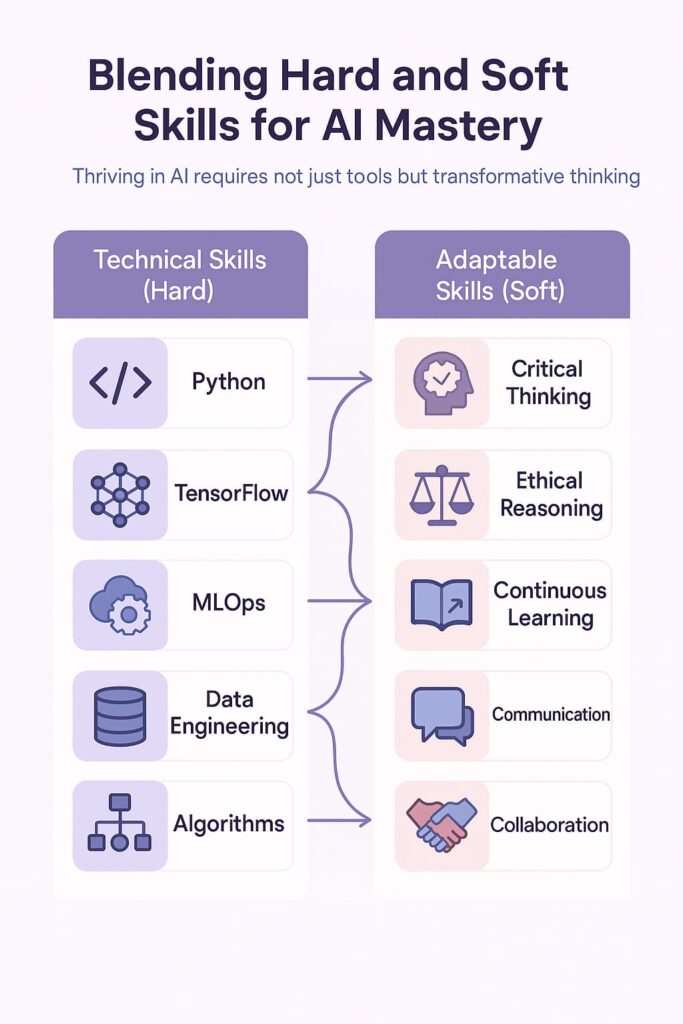
Technical vs Adaptable: Your AI Career Skill Matrix
Two sides form the matrix of skills necessary to sustain an AI career: Technical and Adaptable.
| Technical Skills (Hard) | Soft/Adaptable Skills (Future-Proof) |
| Python Programming | Critical Thinking |
| TensorFlow | Problem-solving |
| SQL | Ethical Reasoning |
| MLOps | Communication |
Technical skills, being the mainstay of the AI field, feel like a natural pre-requisite. Mastery of Python, TensorFlow, SQL, MLOps, and similar skills would undoubtedly open doors in the AI job market.
Contrastingly, adaptable skills are not just the bells and whistles – they are indeed your career’s life jacket in the turbulent seas of AI evolution. Just as vital as their technical counterparts, these skills arm you with the necessary resilience to endure the frenetic pace of change in AI.
The combination of technical proficiency with critical thinking and problem-solving skills can help you deliver robust AI solutions. Ethical reasoning becomes a compass, guiding those solutions’ applications responsibly. Communication skills ensure the alien complexity of AI doesn’t render you alone on an island; they bridge the gap between you and stakeholders of varying technical competence levels.
An innate hunger for continuous learning and acquiring domain expertise keeps your career pliant and responsive to AI’s inevitable revolutions.
So, it is not ‘either-or’ but more of ‘this-and-that’ when you cook up a sustainable mix of skills for your AI career. The balanced blend of technical vs soft skills is what truly ensures vitality and longevity in the dynamic field of AI. This is not simply a cautionary word for the wise, but a career dictum for those revving to make a mark in the AI sphere.
Pathway to AI Position: Craft a Winning Blueprint
1. Start with a self-project: Rather than waiting for a job offer to showcase your skills, hit the ground running. Create a project that uses AI to solve a problem or enhance a process, even if it’s not technical. This illustrates your practical understanding of AI and your initiative.
2. Network with purpose: Engage with AI professionals and enthusiasts online, at conferences, or through job fairs. Aim to understand the landscape and make valuable connections, not just distribute your resume.
3. Understand the AI business spectrum: AI startups and enterprises offer distinctly different environments. Startups demand agility and often allow for broader roles, while enterprises could offer more structure and niche positions. Match your preference and skills with the right type of company.
4. Customize your approach: No two AI companies are identical. Research each business you apply to, tailor your application to their specific needs and culture.
5. Prepare for a new breed of interviews: AI interviews often involve hypothetical scenarios or problem-solving exercises. Beyond the standard interview preparation, anticipate these unique challenges. Read up on real-world AI application and consider potential solutions to common problems in your field.
Cement your place in the AI landscape by following this blueprint. More than just tips, these steps are your compass in the AI job market, leading you towards rewarding and future-proofed career opportunities. This, however, necessitates that you step out of conventional job-seeking comfort zones, inviting a distinct blend of proactiveness and adaptability.
Unraveling the AI Hiring Maze
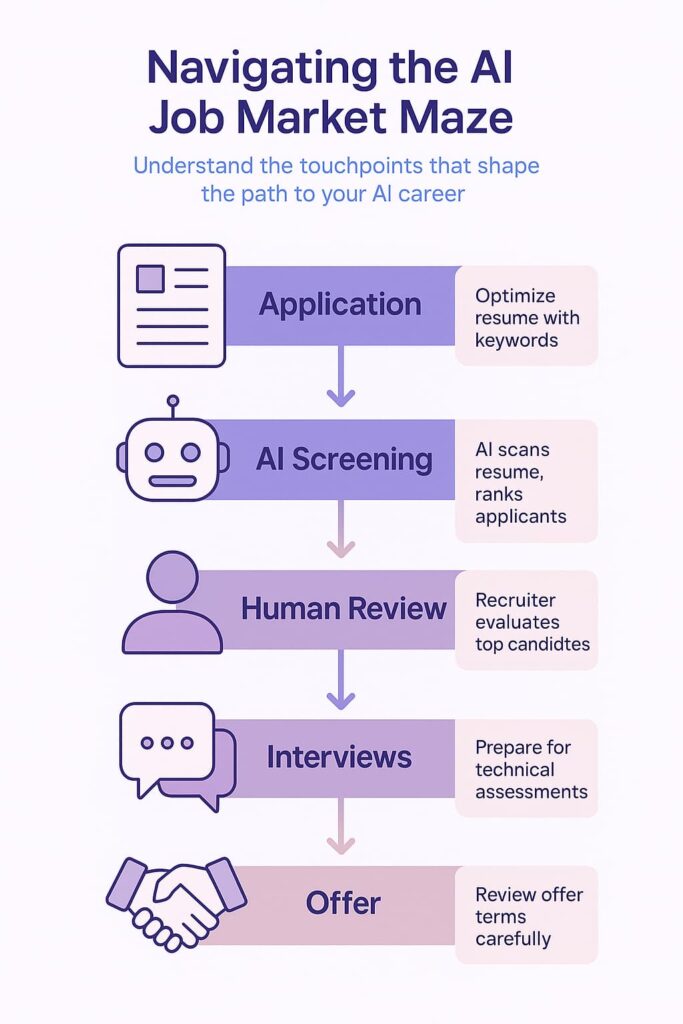
Wading into the AI job market is akin to stepping into an evolving maze. The hiring process, already a labyrinth in conventional fields, complicates further as AI weaves into recruitment itself, a composite blend of human assessment and machine learning tools.
Foremost, recruiters increasingly lean on AI systems for initial screenings. Parameters stretch beyond credentials on a resume or scores on an aptitude test. AI digs deeper, mining from patterns in work history to behavioral traits echoed in cover letters. What strikes a human interviewer later, an AI unveils early on.
From a candidate’s perspective, every application springs a fresh puzzle. Every company’s AI possesses its own decision-making matrix when examining applications, like a unique fingerprint. Comprehending these methods necessitates articulating every hiring step from job advert to job offer into a hiring process flowchart, highlighting the accented traits or skills at each juncture.
TAILOR YOUR APPLICATION – AI scans resumes for repeated patterns in successful hires. Illuminate parallels between your history and promoted responsibilities.
BE PRECISE – AI emphasizes data. Replace ‘excellent teamwork’ with ‘transformed 6-person cross-functional unit into top-performing team within 3 months’.
SHARPEN YOUR LINKEDIN PROFILE – Recruiters commonly use AI tools to shortlist profiles from LinkedIn long before posting job adverts. A meticulously maintained LinkedIn profile can fast-track you to shortlists.
Preparing for AI-shaped recruitment is not merely about gaming the machine-learning algorithm. It’s about understanding that the traditional hiring pathway is extinct. The fusion of human judgement and AI input has rewritten the hiring handbook.
Your triumph lies not in outsmarting the AI but in adapting and evolving in tandem with the puzzle that is the modern AI job market.
Decoding Your AI Career
- ‘Good’ is a personal definition in the context of a career in AI, heavily influenced by one’s resilience, adaptability and passion for continuous learning.
- Selecting a niche with strategic foresight can lead to enhanced opportunities within the AI space.
- AI promises unparalleled growth potential but demands more than just technical prowess. A mindset of innovation, ethical consciousness, and the ability to learn and unlearn are crucial.
- Navigating the AI landscape will test your resilience, especially with the AI-shaped recruitment process that’s unraveling a new rulebook. Being dynamic and flexible can tilt the odds in your favor.
Seize Your AI Future
Unshackled from the hype, you’re on the brink of an exciting venture into AI. Graceful adaptation beats trend-chasing. Testing times lie ahead, sure, but also remarkable opportunities. Crucially, pair your technical acumen with a humanistic touch, a blend that’s prized in the shifting AI landscape.
Keep lighting the spark of lifelong learning to fuel your journey. May your AI career be a carefully strategized adventure, not an aimless drift. Forge ahead, my friend. Your AI future awaits you, and it promises to be as dazzling as your determination to master it.